

Strategy Sells 1,690 Bitcoin as Treasury Management Turns More Active
Strategy has sold another 1,690 Bitcoin, but the more important development is what happened to the cash.
The latest move shows that Strategy sells 1690 Bitcoin not as part of a broad retreat from BTC, but as part of a more active approach to managing its capital structure.
The company sold the Bitcoin for approximately $108.6 million between Aug. 3 and Aug. 9 and used the proceeds to repurchase shares of its STRC preferred stock. The Bitcoin was sold at an average net price of $64,262.
It was the second consecutive week in which Strategy sold Bitcoin to help fund STRC repurchases, adding another layer to how the company manages the world’s largest corporate Bitcoin treasury.
Strategy still holds 840,447 BTC, acquired for an aggregate $63.36 billion at an average purchase price of $75,385 per Bitcoin. The latest sale therefore represents only a small portion of its overall position.
But the direction matters.
For years, Strategy’s Bitcoin story was mainly built around accumulation. Bitcoin entered the balance sheet while capital was raised elsewhere.
That relationship is becoming more flexible.
Bitcoin is now being managed alongside preferred shares, common-stock issuance and a growing dollar reserve rather than treated only as an asset to accumulate.
Strategy Sells 1,690 Bitcoin to Fund STRC Buybacks
Strategy used the entire $108.6 million generated by the latest Bitcoin sale to repurchase 1,152,020 shares of STRC, its variable-rate perpetual preferred stock.
That creates a direct capital flow:
Bitcoin is sold, cash is generated, and the cash is redirected into preferred shares.
The distinction matters because it changes the role Bitcoin plays inside Strategy.
Selling BTC does not necessarily mean the company has become less committed to Bitcoin. It can instead be viewed as a capital-allocation decision, where management uses a small portion of a liquid asset to support another security when the trade-off looks worthwhile.
That is a more active treasury model than simply buying and holding.
The shift is not that Bitcoin can be sold. It is that Bitcoin now has a defined role inside Strategy’s funding decisions.
Following the latest purchases, Strategy still had approximately $785.2 million available under its preferred-stock repurchase authorization. Another $1 billion remains available under its separate MSTR common-stock repurchase program.
That leaves room for further capital-management activity if conditions justify it.
Bitcoin Sales Continue for a Second Week
The latest transaction followed a sale of 1,638 BTC between July 27 and Aug. 2 that raised approximately $104.7 million.
Those proceeds were also used in connection with STRC repurchases.
The back-to-back transactions matter more than either sale viewed individually.
A one-off Bitcoin sale could be tactical. Repeated sales tied to the same objective suggest Strategy is becoming more willing to treat part of its Bitcoin holdings as deployable capital when another part of the balance sheet needs support.
That does not mean a broad liquidation is underway. Strategy still owns more than 840,000 BTC, and the latest transactions remain small compared with its overall position, although previous Strategy Bitcoin sales have raised questions about how corporate treasury selling could affect market supply.
Strategy still owns more than 840,000 BTC, and the 1,690 BTC sold in the latest week represents only a fraction of that position.
Execution matters here because liquidity is not constant. A seller with time can break an order into smaller pieces and trade when buyers are available. A seller that needs cash quickly has less control over timing and price.
The market cares less about whether selling exists than whether the seller controls the timing.
Treasury flexibility changes execution quality. A company with several funding options can choose when to sell, while one relying on a single source of liquidity often cannot.
Over the past week, Strategy’s Bitcoin sales have remained small relative to its total holdings, keeping the activity closer to targeted treasury management than broad supply pressure.
MSTR Share Sales Build a Separate Dollar Reserve
Strategy was also raising cash through another channel.
During the same period, the company sold approximately 6.59 million MSTR shares through its at-the-market program, generating $653.1 million in net proceeds.
Around $650 million of that amount was directed toward Strategy’s US dollar reserve, taking the reserve to approximately $4.65 billion as of Aug. 9. The remaining $3.1 million was added to its general cash balance.
This is where the structure becomes clearer.
Strategy did not sell Bitcoin simply to increase its cash reserve.
Instead, two funding channels were serving different purposes.
Bitcoin sales funded STRC repurchases.
MSTR issuance strengthened the dollar reserve.
That separation gives Strategy more control over capital allocation and reduces dependence on a single funding source.
It can raise cash through equity issuance while using smaller Bitcoin sales for specific balance-sheet decisions.
That matters because investor demand for new shares can change with market conditions. If equity issuance becomes less attractive, having several sources of liquidity gives Strategy more flexibility over how it raises cash.
Bitcoin Price Chart Shows Treasury Selling in Context
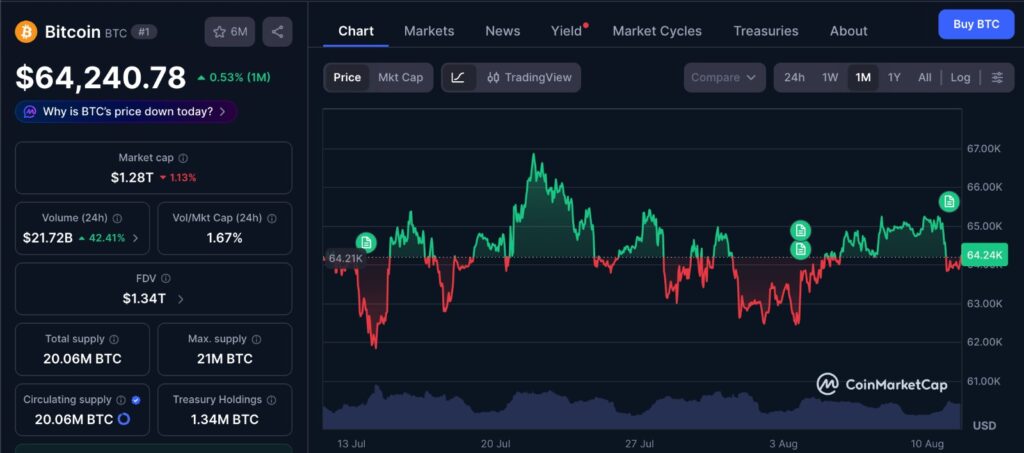
Bitcoin’s one-month price chart provides useful context for Strategy’s recent treasury activity. The company has sold BTC across two consecutive weeks, but the amounts remain small relative to both its total holdings and the wider Bitcoin market. The more important signal is whether spot demand continues absorbing available supply without a meaningful change in the broader price structure. If Bitcoin remains relatively stable while Strategy conducts selective sales, it would support the view that these transactions are primarily balance-sheet decisions rather than a significant new source of market pressure.
That context matters because spot buyers can offset new Bitcoin supply when selling remains limited and enough demand is available on the other side.
If BTC remains stable despite selective corporate selling, it would suggest that Bitcoin demand is still absorbing available supply rather than allowing relatively small treasury sales to materially change the broader market structure. If larger treasury sales begin appearing alongside weaker demand, investors may reassess how much corporate Bitcoin could eventually become available to the market.
Why the $4.65 Billion Reserve Matters
A larger dollar reserve gives Strategy a buffer between Bitcoin volatility and its recurring financial obligations.
Bitcoin does not generate predictable dollar cash flow simply by sitting on the balance sheet. Preferred dividends, interest and other obligations ultimately require dollars.
By holding a larger cash reserve, Strategy reduces the risk that routine payments force it to sell BTC at an unfavorable time.
That distinction matters.
Voluntary selling gives management more control over timing and position size. Forced selling reduces that flexibility and can lead to poorer execution.
Selective BTC sales and a larger cash reserve are therefore not contradictory. One provides targeted liquidity, while the other reduces the likelihood that Bitcoin needs to be sold under pressure.
STRC Recovery Gives the Buyback Strategy a Test
STRC has recovered from its June lows and was trading around $95 ahead of Monday’s regular session, still below its $100 stated value.
That makes Strategy’s continued repurchases worth watching.
Buying preferred shares below their stated value can make the use of capital more attractive, but the broader test is whether Strategy can support those securities without steadily increasing the amount of Bitcoin it needs to sell.
If STRC continues recovering, the recent BTC sales may look more like targeted balance-sheet management.
If weakness returns and Bitcoin sales grow alongside it, investors may start asking how much of Strategy’s treasury could eventually be used to support the rest of its capital structure.
There is not enough evidence yet to assume that outcome.
The latest transactions remain small relative to Strategy’s Bitcoin holdings.
What matters now is the relationship between future BTC sales, STRC performance, MSTR issuance and the size of the company’s cash reserve.
Those factors will provide more information than the fact that Bitcoin was sold.
Bitcoin Is Becoming Part of a Broader Treasury Strategy
Strategy’s evolving approach also has implications beyond one company.
Corporate Bitcoin treasury strategies are often judged by a simple metric: whether companies are buying or selling BTC. Strategy’s earlier purchases were often interpreted as a test of corporate Bitcoin accumulation and investor confidence, but its recent activity shows that treasury management can work in both directions.
That misses an important part of the equation.
A company holding Bitcoin alongside common shares, preferred securities, debt and cash reserves has to manage those pieces together.
Bitcoin is becoming part of Strategy’s broader capital-management toolkit.
The value of that treasury therefore depends not only on Bitcoin’s price, but also on how efficiently the company can raise capital, meet obligations and access liquidity without being pushed into unfavorable transactions.
Recent activity provides a practical example.
Strategy has sold relatively small amounts of Bitcoin while simultaneously raising substantially more cash through common-stock issuance.
That means Bitcoin is not carrying the full funding burden.
Investor perception also depends on why the selling is happening.
A small BTC sale can carry limited significance when it appears planned and targeted. The same transaction can send a different signal if it becomes part of a growing need for cash.
That distinction is more important than the headline size of any single sale.
What Investors Should Watch Next
The immediate Bitcoin sale is not large enough by itself to materially change Strategy’s overall exposure.
The pattern behind it deserves more attention.
Three developments now matter.
First, whether Strategy continues selling Bitcoin to fund additional STRC repurchases.
Second, whether STRC can move closer to its $100 stated value as those buybacks continue.
Third, whether Strategy can keep building its dollar reserve through capital markets without needing substantially larger Bitcoin sales.
Together, those factors will show whether the current approach remains controlled.
If Strategy can keep BTC sales limited while maintaining access to other sources of capital, its Bitcoin exposure remains largely intact even as treasury management becomes more active.
If Bitcoin begins carrying a larger share of the funding burden, investors may interpret those sales differently.
For now, Strategy sells 1690 Bitcoin as part of selective capital management, not as evidence of a broader retreat from BTC.
Editor’s View
Strategy selling 1,690 BTC is less important than the reason the Bitcoin was sold.
The company still owns 840,447 BTC, so the transaction does not represent a wholesale retreat from its Bitcoin strategy.
What has changed is how Bitcoin fits into the balance sheet.
For now, MSTR issuance is doing far more of the work in building the company’s cash cushion, while Bitcoin sales remain limited and targeted.
That balance is the key signal.
If Strategy can continue raising outside capital and use BTC selectively, the treasury remains flexible without placing more pressure on its Bitcoin holdings.
The more important question is whether that flexibility remains intact as capital needs change.
Optional liquidity strengthens a treasury. Required liquidity changes how investors value it. That distinction is likely to matter far more than the size of any individual Bitcoin sale.
Disclaimer: This content is for informational purposes only and does not constitute financial advice.
 Bitcoin
  Ethereum
  Tether
  BNB
BNB  XRP
XRP  Solana
  TRON
TRON  Dogecoin
  Litecoin
  Pepe
Pepe